Beautiful photography
locations in Berat
Albania’s hidden gem Ottoman city
Berat is easily one of Europe's prettiest towns and the whole city centre is a UNESCO World Heritage site. But while Albania’s beaches are becoming well-known, its historic towns are still hidden gems. Should you visit? If you like history or beautiful old cities, then Berat might be right up your street.
Berat is one of several Ottoman-era cities in Albania, a country in southern Europe, on the Adriatic coast between Greece and Montenegro - see my page on Gjirokaster city for more Ottoman architecture in Albania.
On this page I’ll cover:
The Kala (castle) - Berat’s walled fortress. Inside the Kala, you’ll find
Introduction to Berat
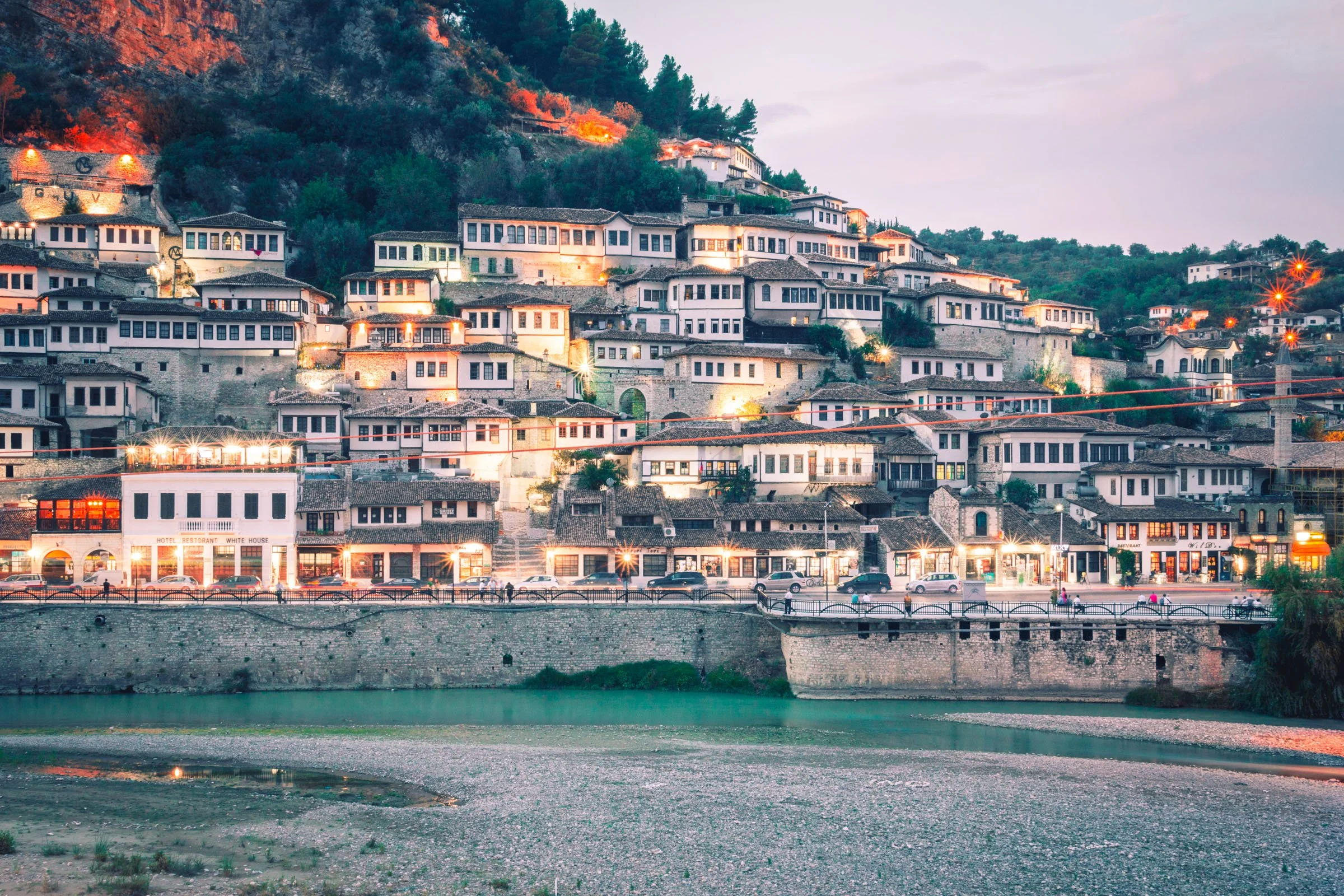
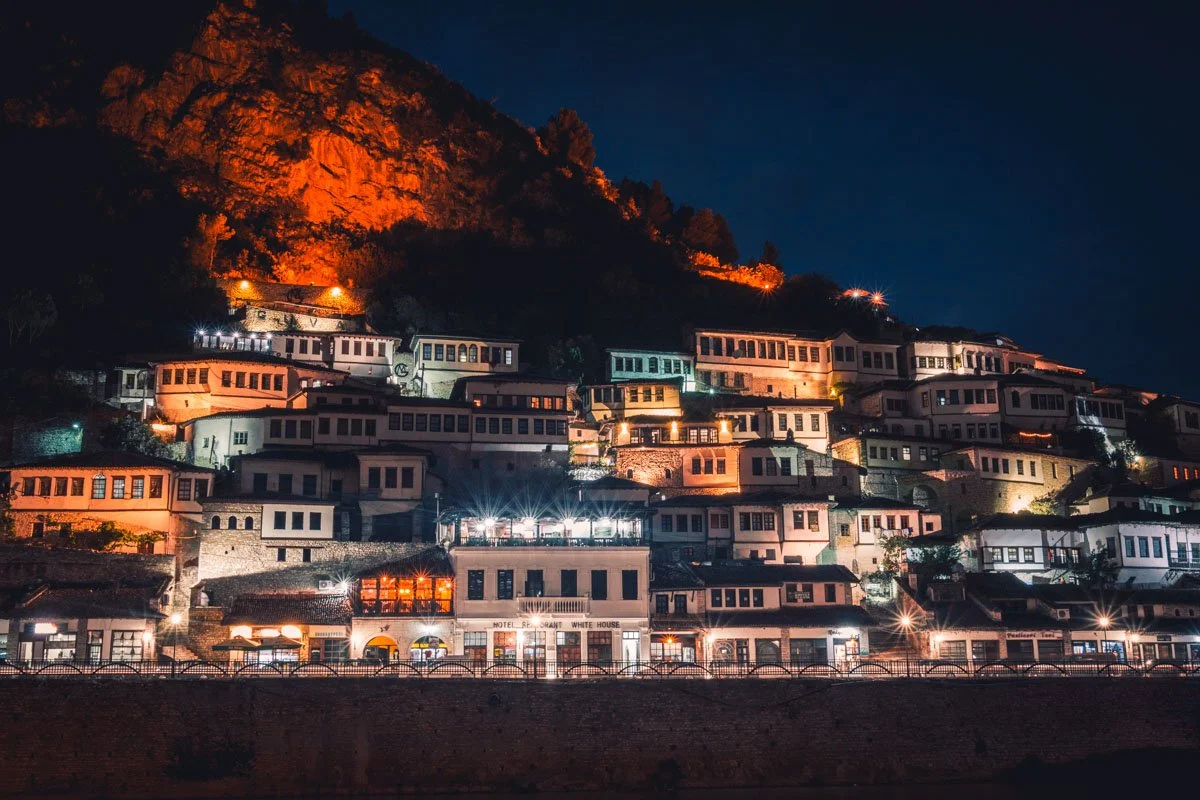
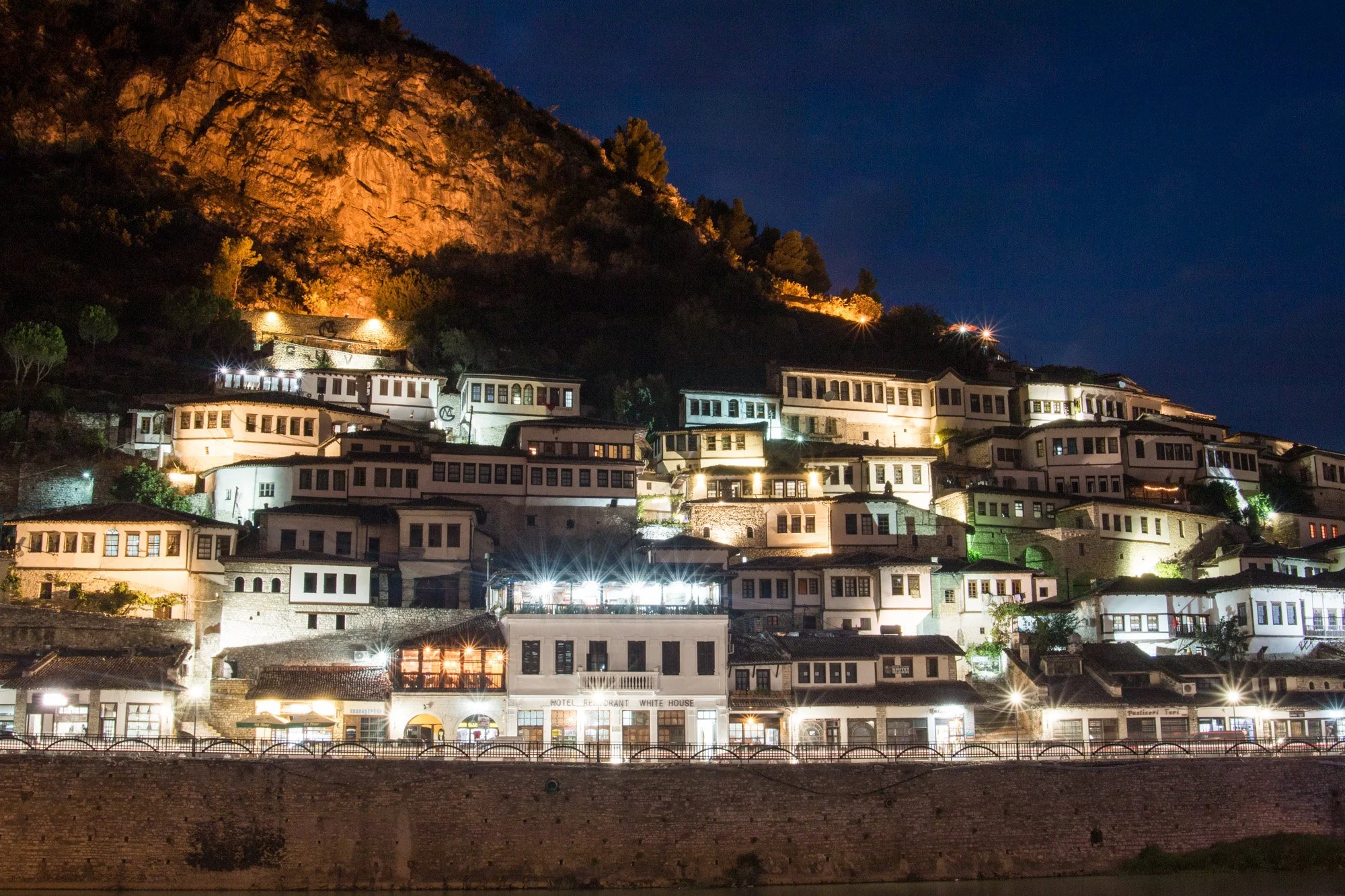
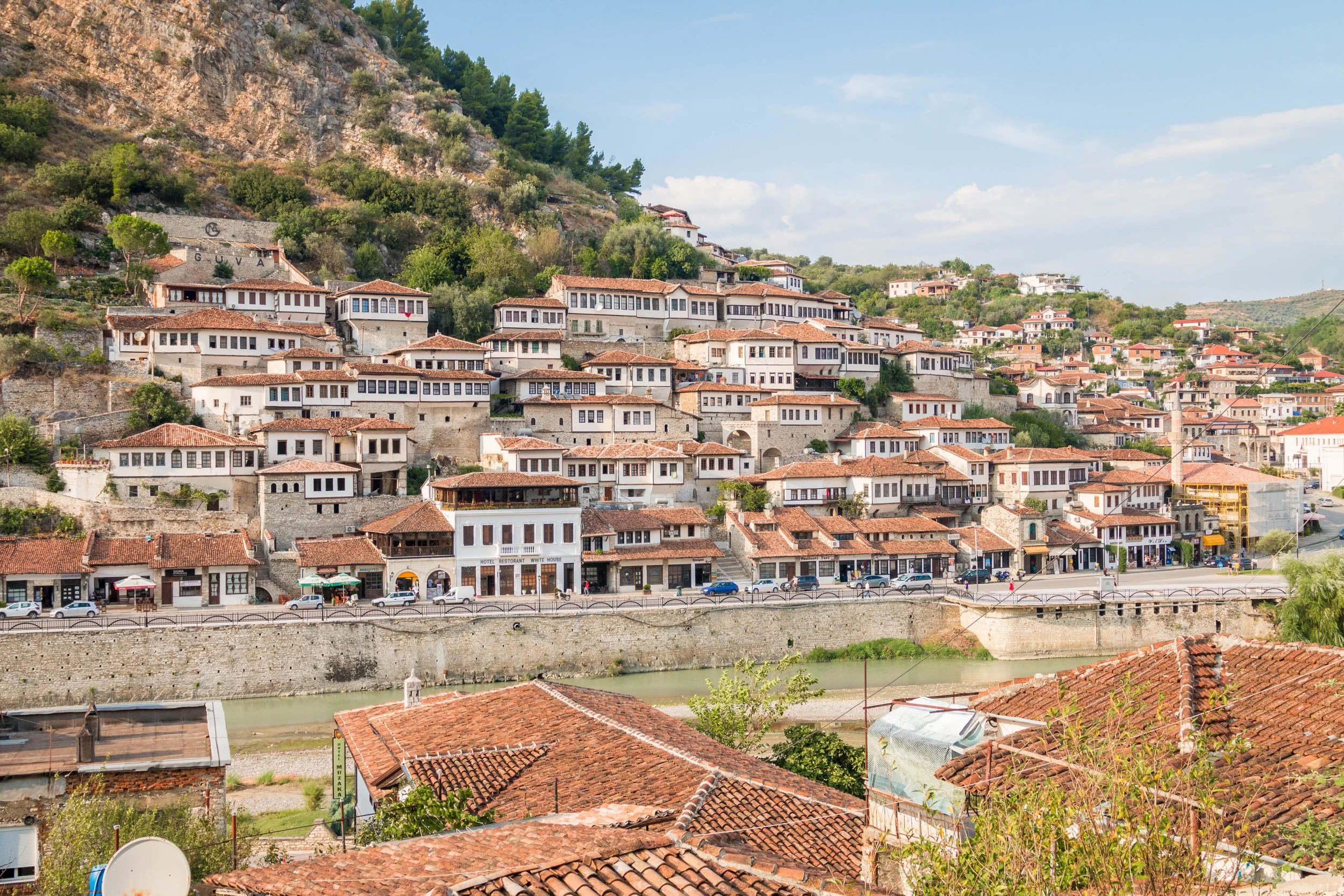
If you are visiting Albania, I think that Berat is definitely worth seeing. The old city is brim-filled with Ottoman-era houses: whitewashed, terracotta-tiled and generously scattered with distinctive wooden-shuttered windows. In fact, there are so many that Berat is nicknamed “city of a thousand windows”.
Berat has been a powerful fortress for over 2000 years. You’ll immediately see why, if you visit: its dramatic location high above a cliff-edged gorge offers a panoramic vista over the nearby plains, as well as control over a key river. Never ones to pass over a strategic location, the Romans established a fort here, which was later extended by the Byzantines, who added churches and walls until it gradually transformed into a fortified village. Later, the Ottomans used Berat as a trading centre, attracting skilled crafts people.
By the 18th century Berat had become one of the most important cities in Albania. As the population grew in number and prosperity, lovely new mosques, townhouses, markets and mansions were added to house the newcomers, spilling down the hill and lining the river below. Many buildings you can see today date from this period, although plenty of traces of the Byzantines and Romans still exist.
Getting to know the city
Berat straddles a river that runs through a tight gorge. On one riverbank sits Gorica neighbourhood, all narrow cobbled lanes tucked tightly under a cliff. And across the river is Mangalem, a more open area of squares and streets that curls around a mountain top, crowned with a walled citadel (the Kala).
You could see many of the attractions here on a (fairly rushed) one day visit. However, I recommend staying for several days - it’s a very attractive place to spend time.
The Kala
Forming the heart of Berat’s old town, the Kala is the old walled citadel: a huge fortress enclosing an entire old city.
Occupying a steep hilltop, the Kala is an obvious location for a castle and there have been fortifications here for thousands of years. Under the Byzantines, Berat grew into a richly fortified town covering the hill, filled with monasteries, craft shops and homes. Astonishingly there were once 42 churches inside the Kala, although only 8 made it through the Communist period and still stand today. Essentially an entire village lived up here, protected by the forbidding walls and the cliff edges below. The oldest parts seen today date to the 1300s, although, with such a rich history, buildings within date from different historical periods.
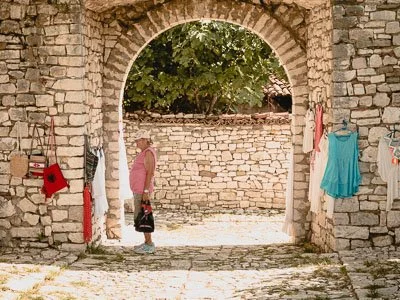
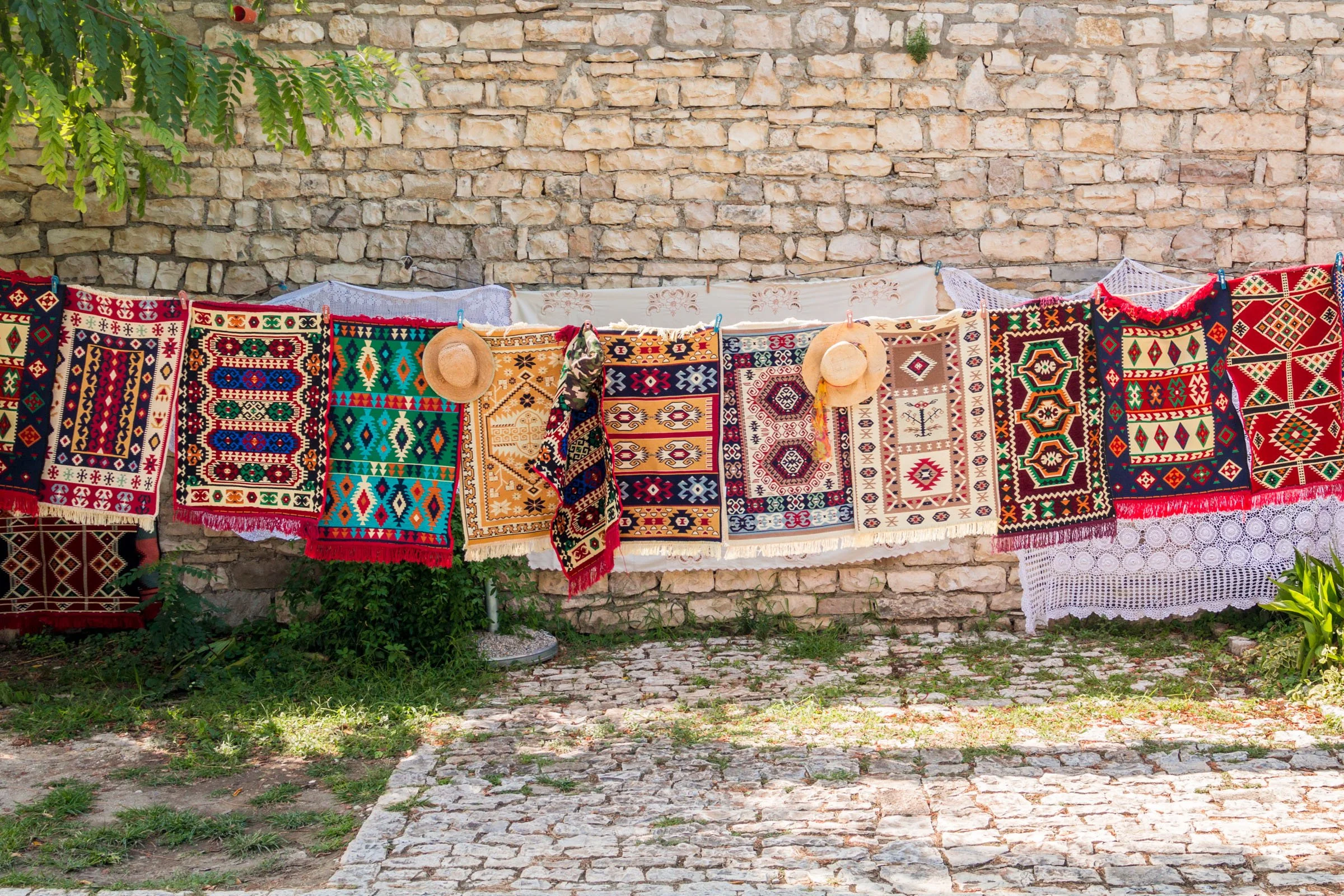
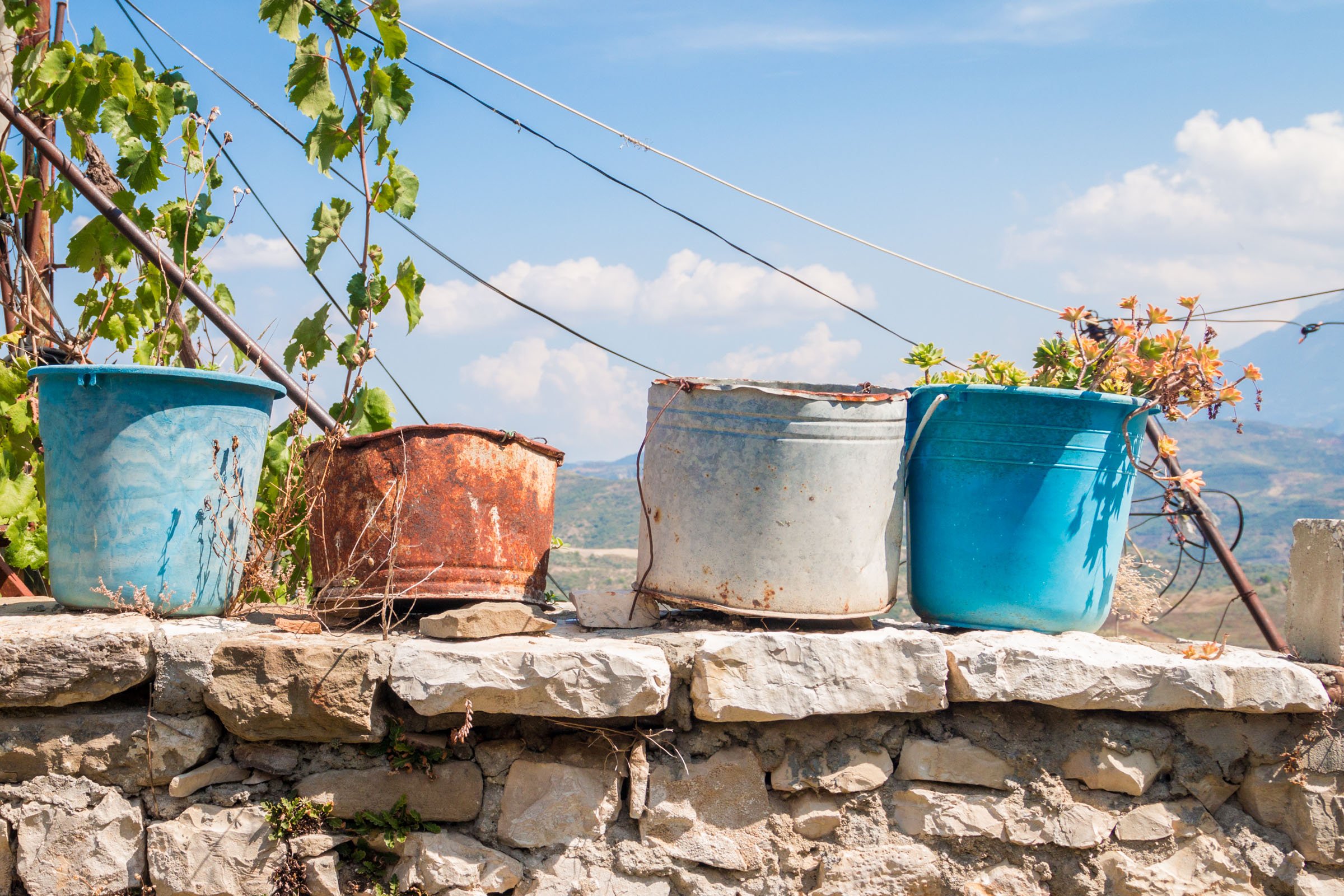
Today, alongside crumbling ruins are cobbled streets, walls topped with bright flowerpots, homes enclosed in lush walled gardens, breezy cafes with open-air benches, shops bedecked with Albanian embroidery and terracotta-roofed guesthouses.
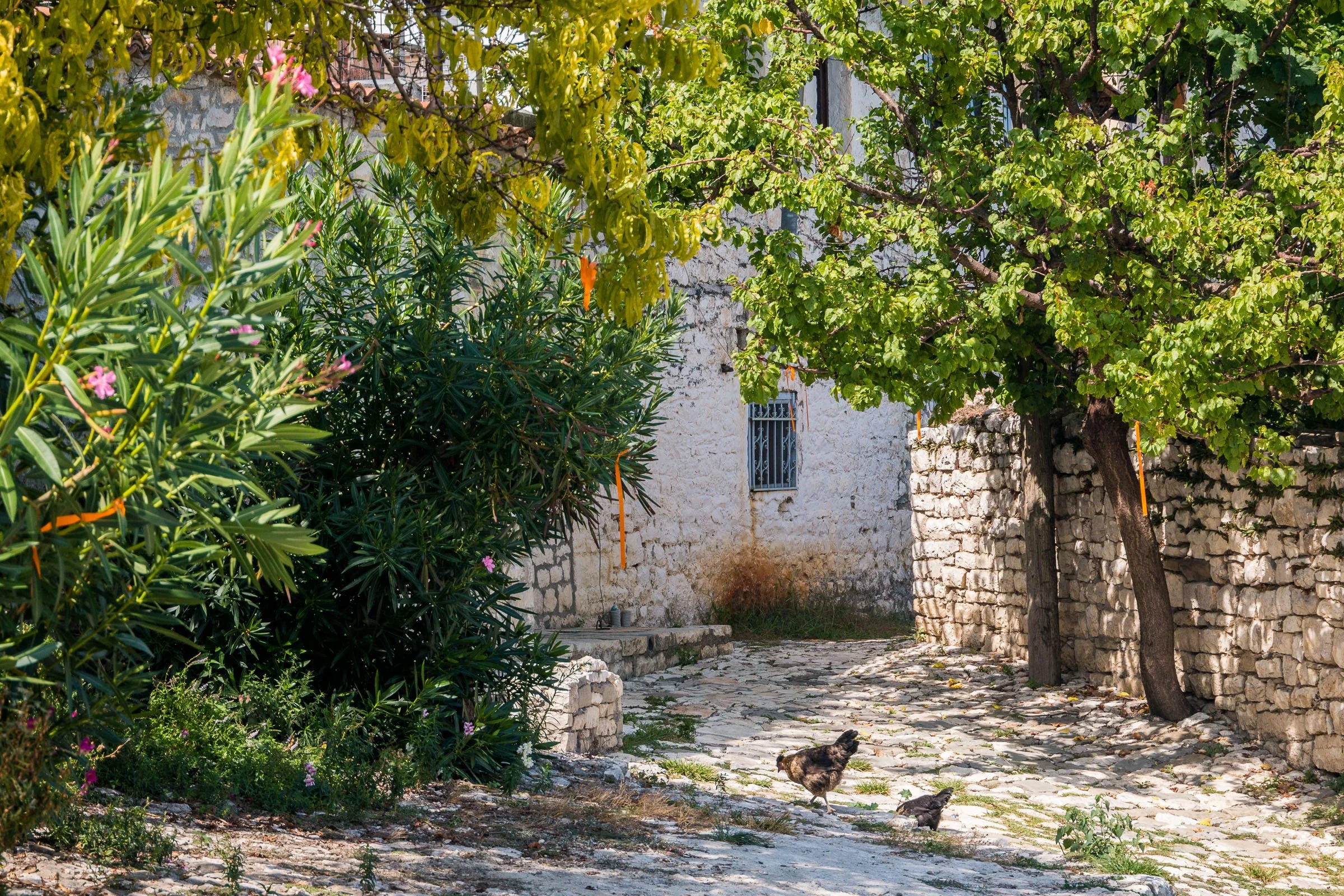
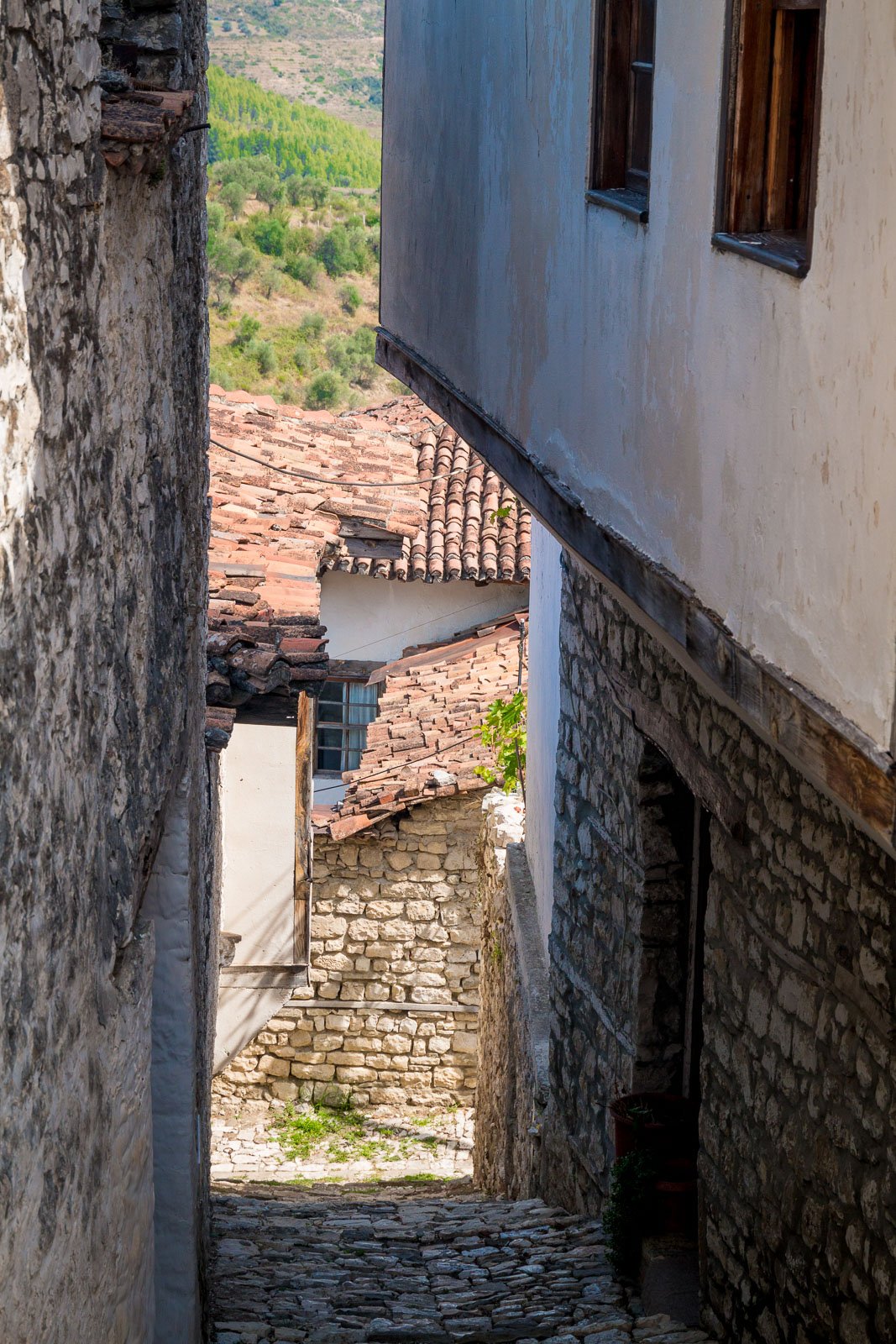
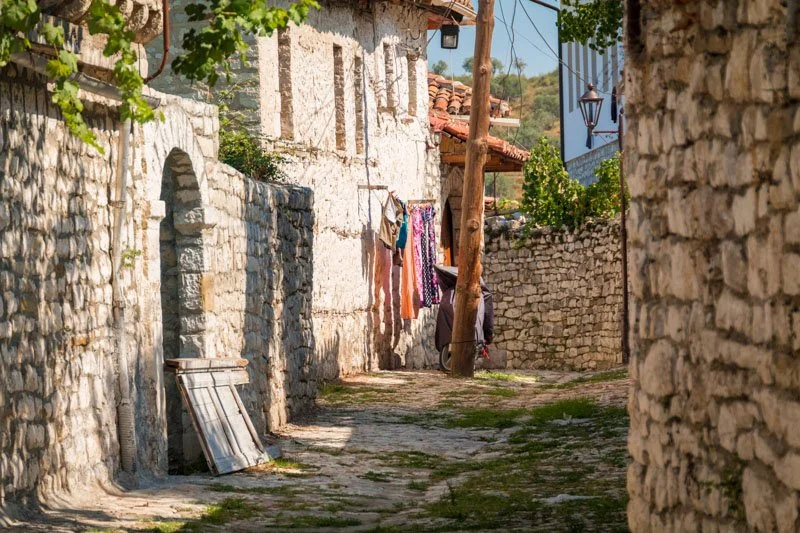
The Kala offers great photography potential, particularly if you like street photography or architecture, if you like homing in on details such as brickwork, or if you like expansive views. You can walk around the Kala’s circumference, following the course of the fortified walls which provide stunning vistas of both hills to the south and plains to the north.
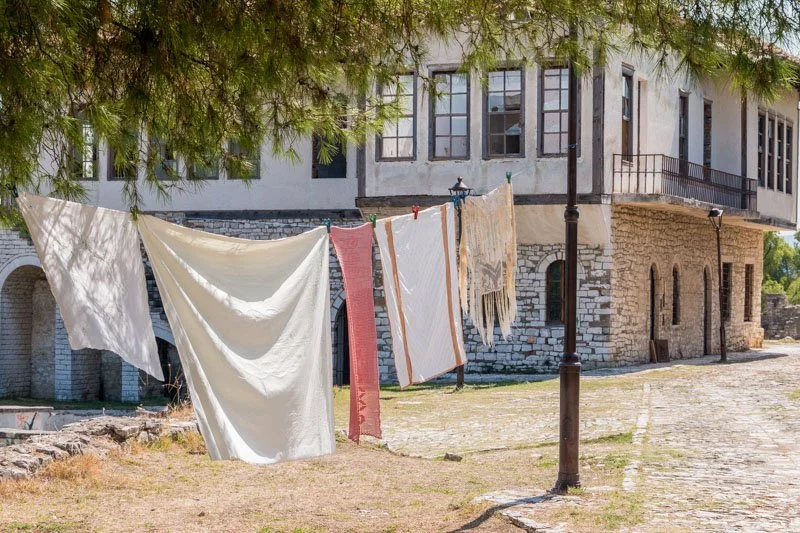
For street photography and architecture photography, the citadel is filled with tiny streets of slippery cobbles with lots of opportunities. Textile shops hang embroidered linens decoratively from walls and wheelbarrows and from lines strung between trees. Meanwhile every scene features stonework or sun-blasted terracotta tiles lingering in the background.
If you're more interested in landscapes, there are scenes of the surrounding valleys visible above the terracotta roof tiles. The Kala occupies a hilltop, so throughout there's always some part facing the sun until evening. The Kala itself opens at 9:00 and is often open until 18:00 which might offer some nice late afternoon light (check all opening hours before making any plans, as they vary).
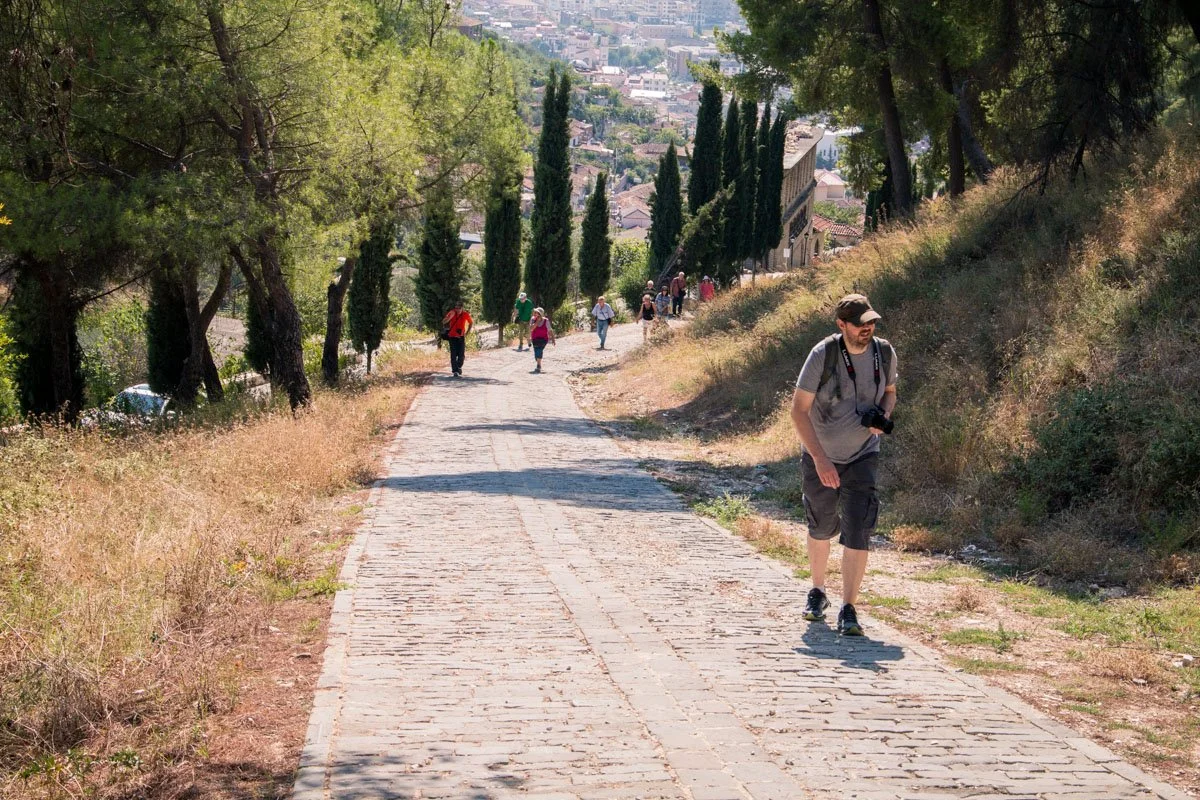
Accessing the Kala
The main ticket office into the Kala is most easily accessed by heading up the Rruga Mihal Komnena, which is a 1km long, steep, straight cobbled road heading from the commercial centre of old Berat towards the Kala ticket office. It’s impossible to get lost and the road surface is good quality cobble and very walkable. However, as it’s steep it can become a demanding 1km walk steeply uphill if undertaken in the summer heat. Go early to avoid the midday sun. Cold drinks are readily available at the top. There are alternative footpaths from the river level to the Kala on the western side (near the Church of the Holy Trinity) and the south eastern corner (near the Church of Saint George).
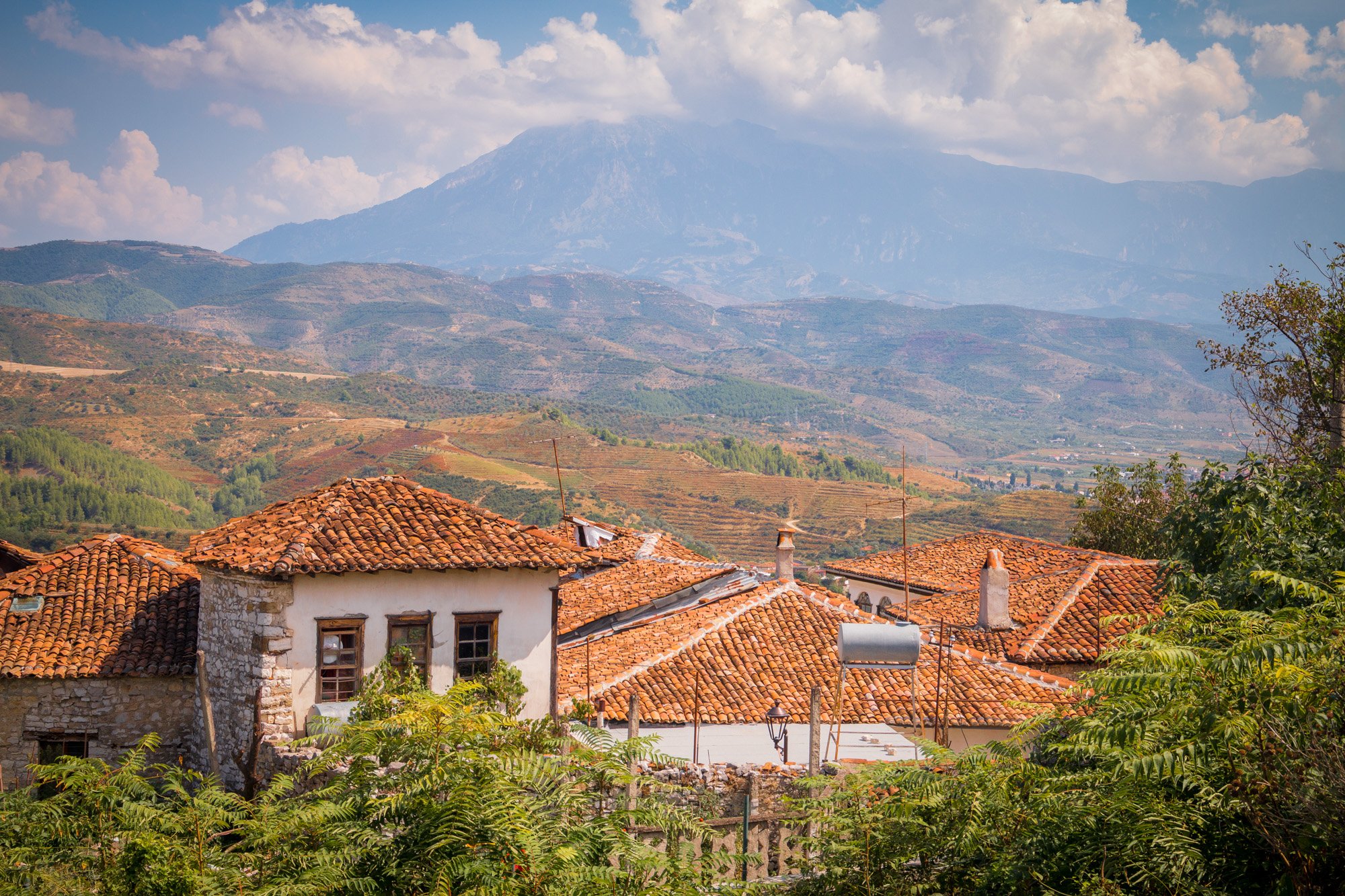
The Kala covers a large part of historic city centre and a number of attractions are enclosed inside. Details of some attractions inside the Kala are below – although I found it well worth wandering around the Kala itself as well, even if not visiting attractions.
Inside the Kala
Church of the Holy Trinity
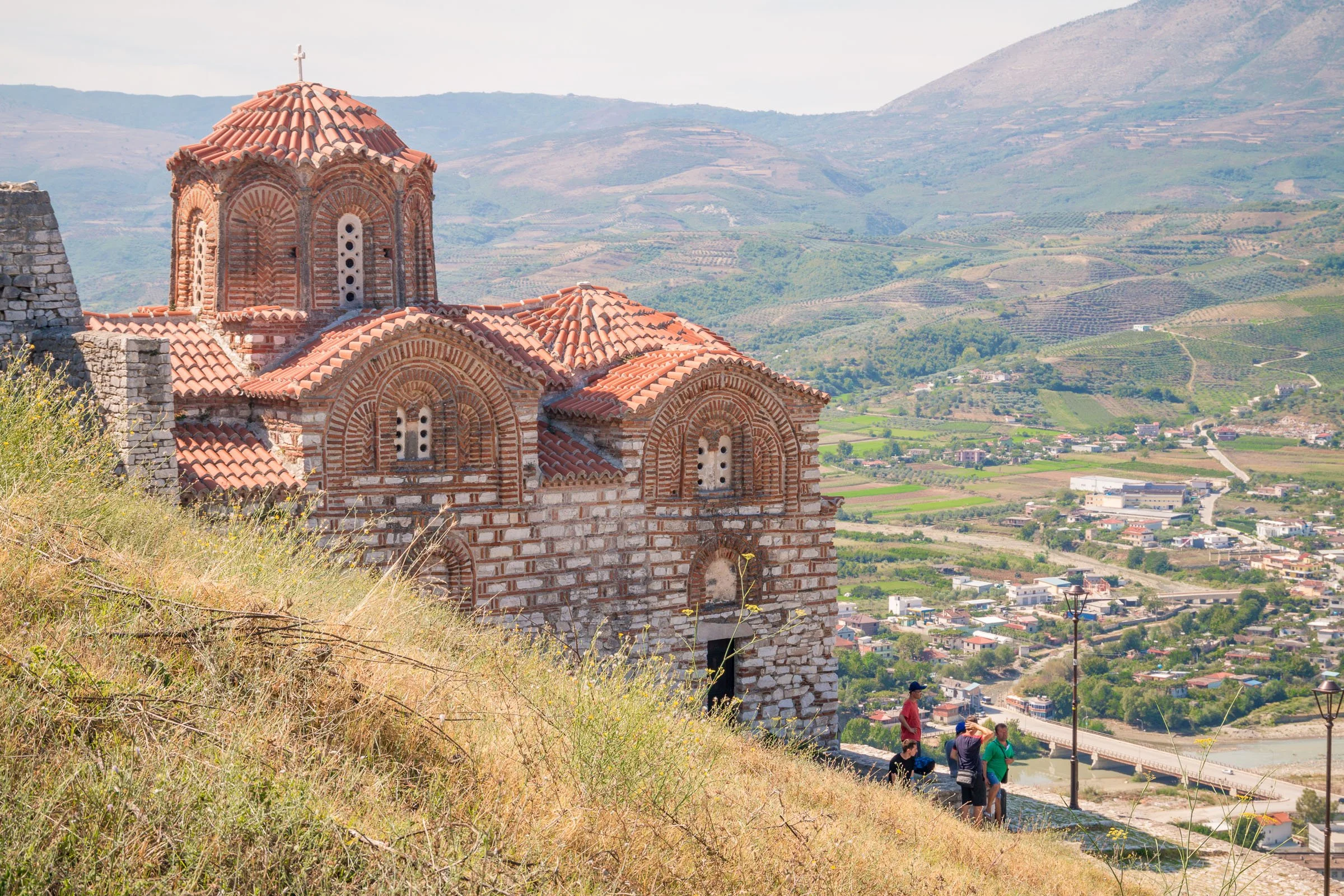
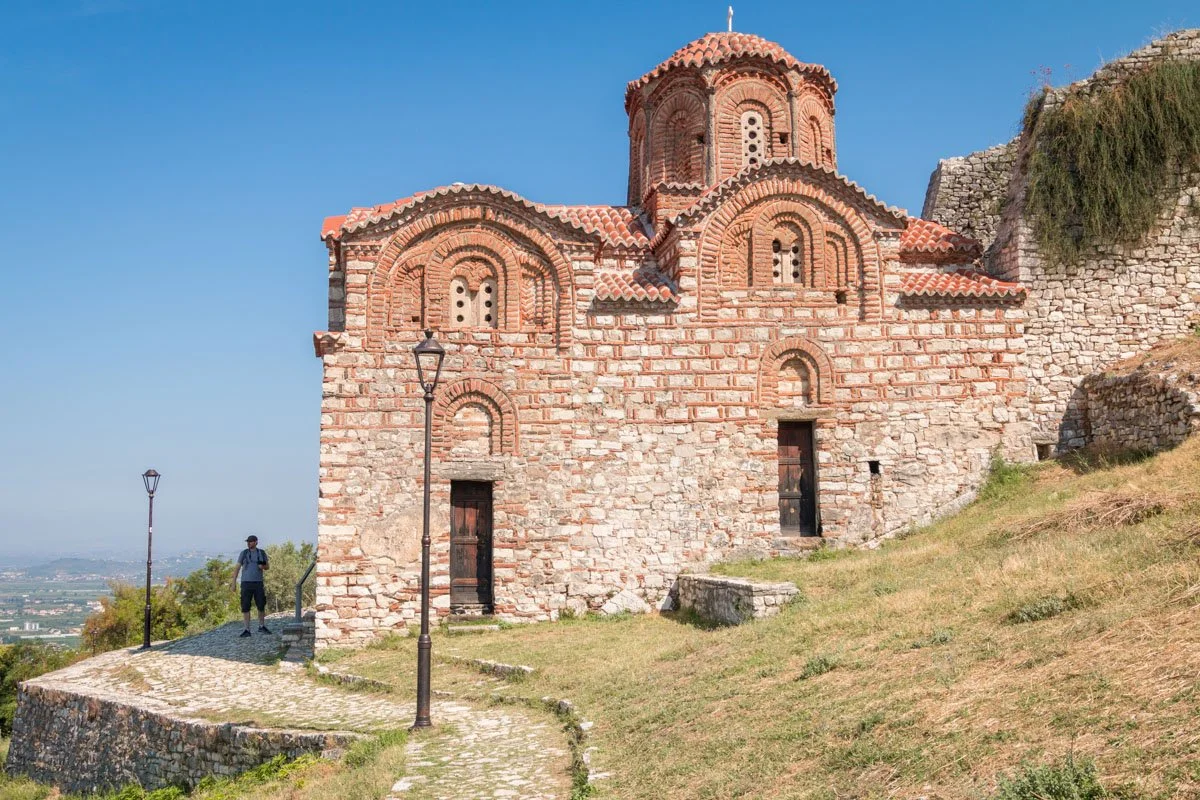
This church is a ruined 800-year-old brick building, lingering on a cliff-edge, with a scene-stealing backdrop of high-towering hills across the river gorge, and hazily distant valleys to the north. Crumbling inside, it sits prettily above all this landscape, its walls featuring striped patterns of slim pink bricks and rough local stone.
It sits defiantly alone, just outside the Kala walls. Facing almost due west, it is an obvious place to visit in the afternoon for sunset light. However, it is open to the sun on each side, and so it's possible to see it in different lighting conditions at different times of the day. The valley below runs north-south and catches light differently during the day, so it's worth visiting at different times to see the valley hills in varying lighting conditions. In the evening, the sun strikes the church, but mountains to the west may be contrasted in shadow. In the morning, you may be able to capture the mountains across the valley illuminated in the sun as a backdrop.
Ruins of the Red Mosque
Near the Church of the Holy Trinity, is the ruin of the Red Mosque, tucked closely inside the old citadel walls. It's not recorded exactly when it was built, but it was probably constructed in the 1400s shortly after the Ottomans arrived in Berat, making it one of Albania's oldest mosques. It would have been used by forces stationed in the city, and probably by traders passing through. Although ruined, you can still see a lot of architectural details here. The mosque was built partly using red bricks, hence the name.
The neighbourhood around here – including both the Red Mosque and the Church of the Holy Trinity - is the oldest remaining part of the Kala, largely constructed in the 13th century and today mostly ruins. It's thought that some of the building materials here may have been borrowed from older, Roman ruins nearby – certainly much easier than making your own bricks and transporting them here.
Church of Saint George
This former church inside the Kala dates from the 18th century – making it much younger than either the Red Mosque or the Church of the Holy Trinity. While the older buildings occupy the wilder, steeper western edge of the Kala, the Church of Saint George sits comfortably on the more serene southern tip of the Kala, surrounded by whitewashed streets, embroidery-bedecked trees and shiny-worn flagstones.
As you walk around the Church of Saint George, you'll notice that the ground floor looks very different to the first floor. In the 1980s the church - now deconsecrated - was acquired by the government. Upper floors were demolished and rebuilt into a museum that illustrates the style of typical Berat house.
Peeking through the trees around here, you can catch glimpses of sun-baked traffic in the modern city far below. Behind the church is a walking route back down to the modern city, down steeply-descending stone steps. You really get a sense of how high and steep the citadel hilltop is from here. It’s possible to get photographs of the stone walls with the sun flashing off the ant-like cars on the streets below, providing a sense of scale.
Onufri museum
This museum is housed in a 10th century church in the Kala, beautifully exhibiting religious icons. The particular focus is on the rich work of the icon painter Onufri, who lived in 16th century Berat. Religious icons are an important part of Eastern Christianity and of Byzantine art generally (here’s a great article that explains a bit more about icons).
Onufri was a Venetian-trained painter who established a painting school in Berat and eventually became one of the most important painters of Eastern Orthodox Christian murals and religious icons. Due to his influence, over the next few centuries Berat became a famous centre for painting, and skilled craftspeople. Architects and artists of all kinds flocked to Berat, establishing artisan guilds and fuelling a construction boom of elegant townhouses.
Things to see outside the Kala
City Mosques
As the city became a trading centre under the Ottomans in the 16th century, the population boomed with newcomers. The Ottoman empire encouraged integration across the Empire, offering excellent career opportunities in the military or in politics and tax breaks in exchange for service. By the late 1600s, Berat had become a diverse city with Muslim, Greek and Orthodox Christian populations. There was also a Jewish community. The Mangalem area emerged to become the Muslim neighbourhood, and mosques with slim minarets appeared along the riverside. Meanwhile, Gorica, across the river, emerged as the neighbourhood for the Christian inhabitants.
Berat’s communities continued this tradition of tolerance of religious diversity up to the twentieth century. During World War 2, some Muslim and Christian households helped to protect their Jewish neighbours from persecution.
Historical mosques cluster near the footbridge that connects Gorica with Mangalem. The Bachelor’s mosque was built for the city’s unmarried male shopworkers in the 19th century. The 16th century Leaden mosque is easily spotted by its lead dome. Meanwhile, the King’s mosque is amongst the older mosques in the country. It’s one of several old mosques in Berat; the Red Mosque inside the Kala is even older, although it is a ruin and no longer in use. At the time of my visit it was closed for building work so I could not see inside, though.
Gorica
Gorica neighbourhood spreads languidly along a narrow strip of riverbank, opposite the Kala. Reach it via Gorica bridge or the footbridge.
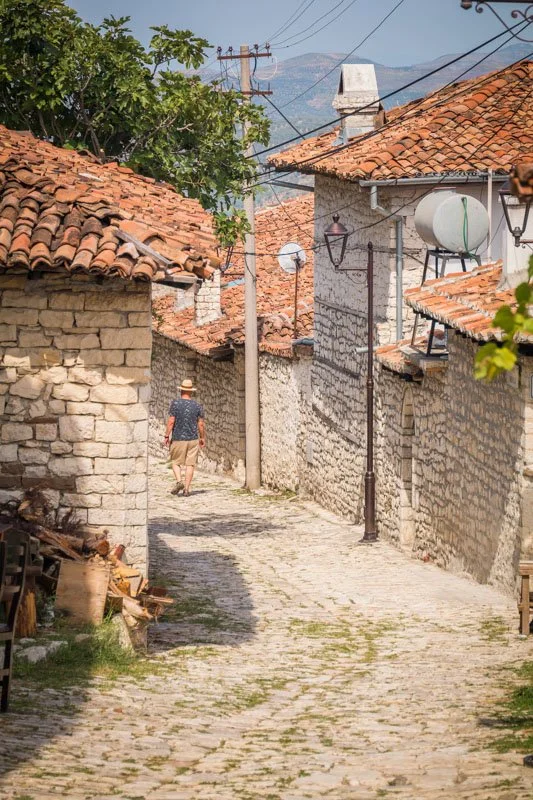
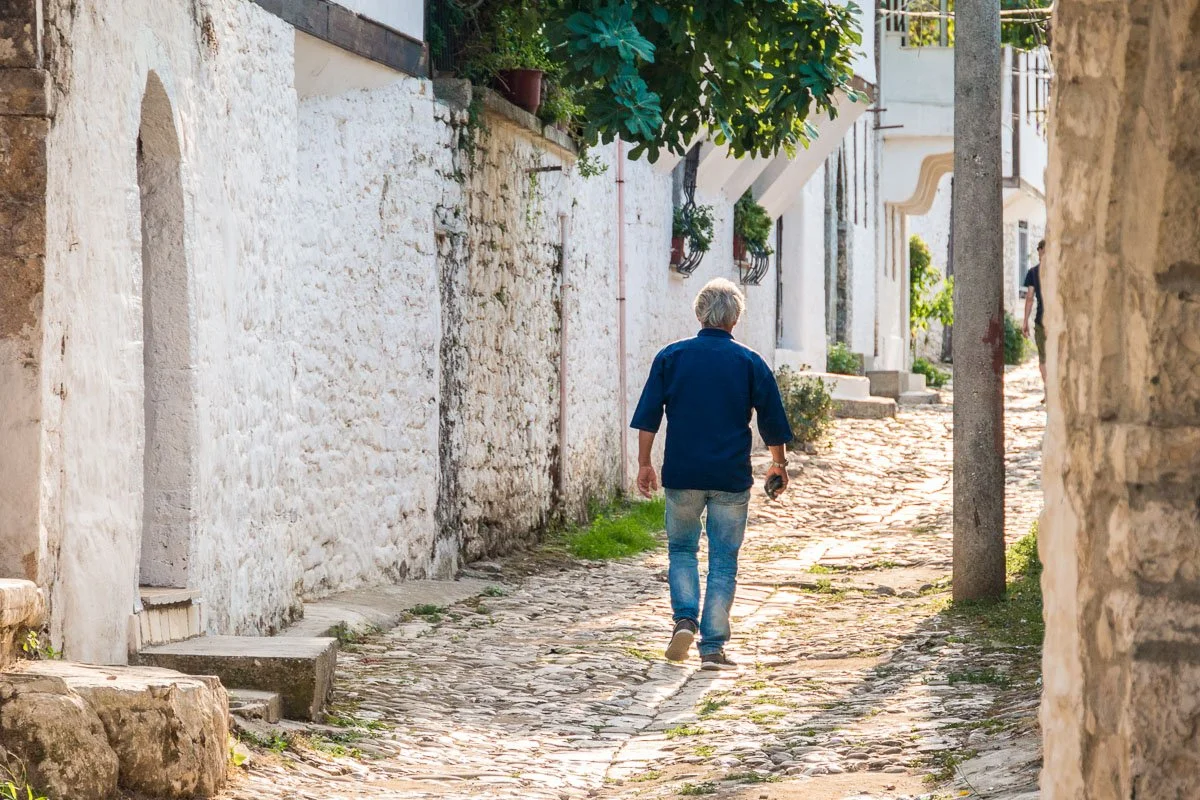
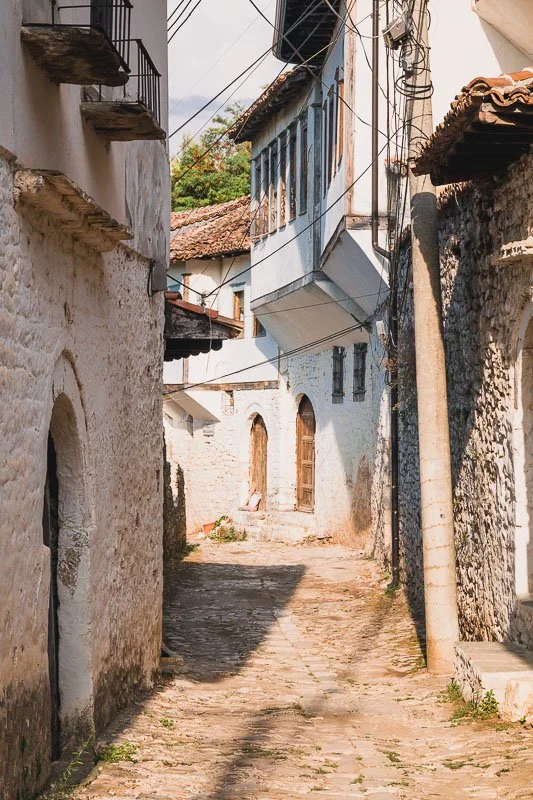
Long and thin, Gorica neighbourhood is tucked tightly under white river gorge cliffs and consists of long streets running parallel to the river. The streets are too narrow for vehicles, making for a quiet and slow-paced neighbourhood, cobbled in shiny old stones trodden by locals and tourists. Houses with heavy wooden front doors and overhanging upper stories shade the streets and generous heaps of plant pots splash the stones with greenery.
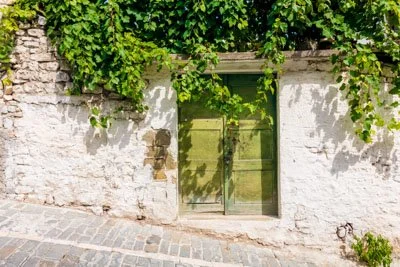
The summer casts low sunrays directly along the streets in late afternoon, so if you like street photography you can shoot narrow cobbled streets backlit by the sun. For architectural photographers there are many beautiful architectural details here, such as wooden gates and ornate door knockers. As always, be aware of people’s homes here and try not to be a nuisance or annoyance.
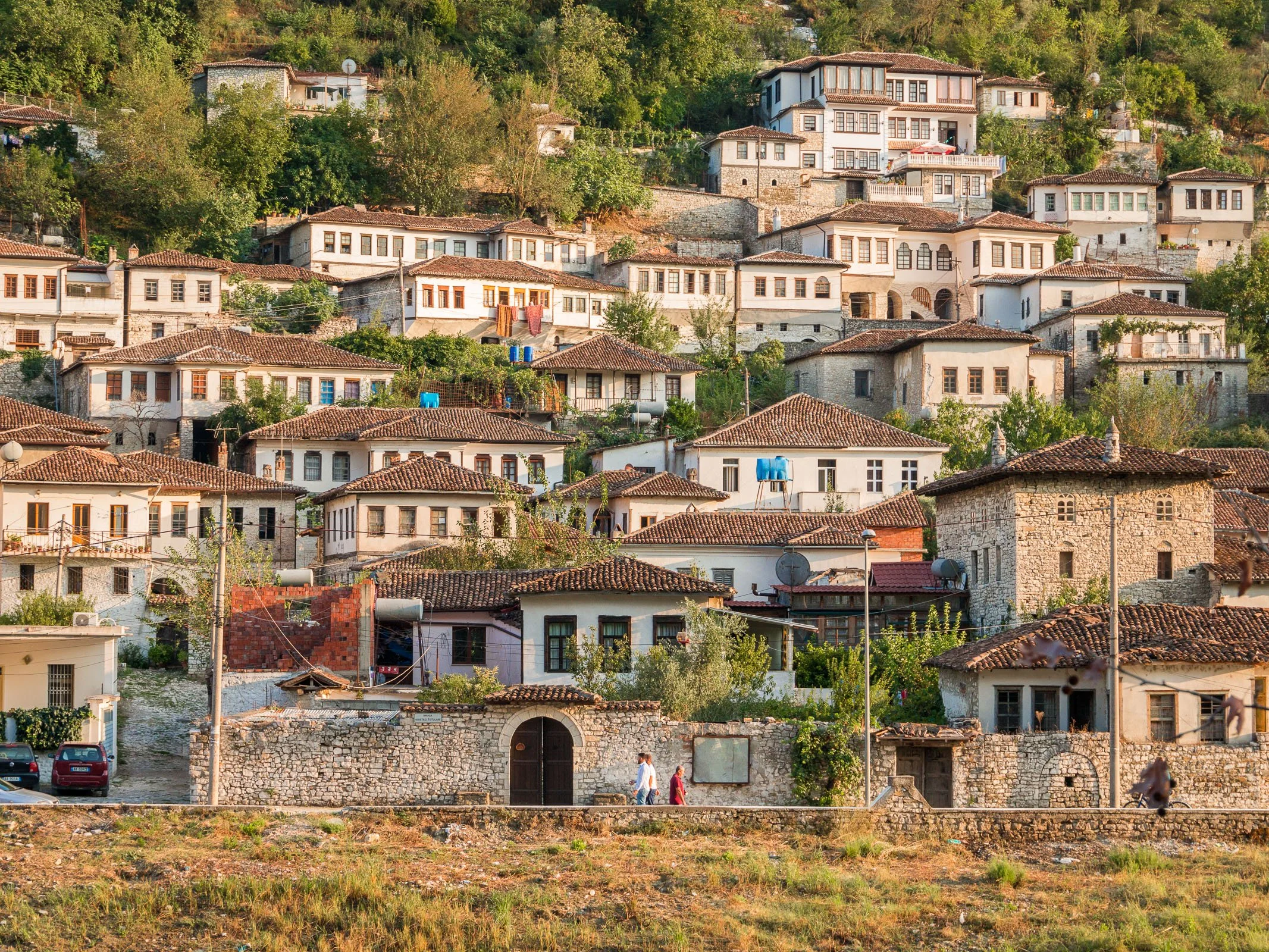
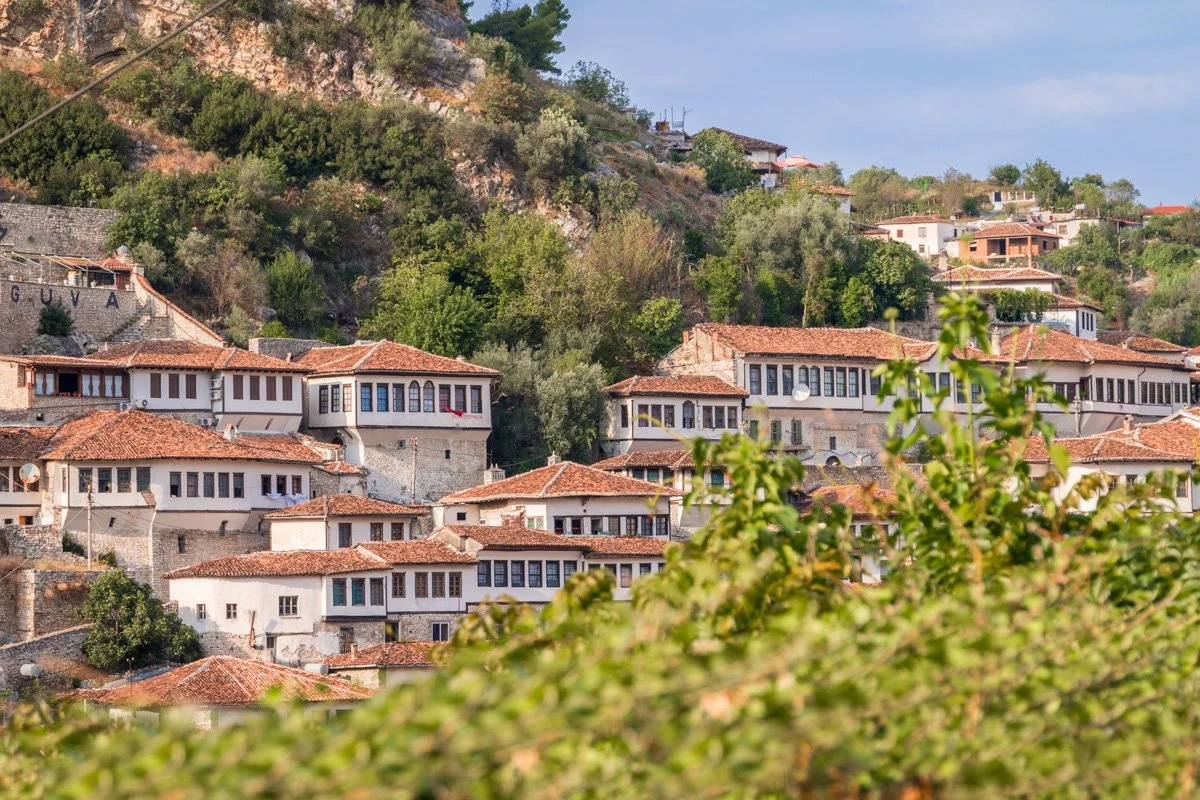
Gorica also offers interesting shots back towards Mangalem, particularly the classic shots of houses and mosques along the waterfront, backed by the steep Kala. Berat’s famous walls of endless wooden mullioned windows are clearly visible here. It's worth wandering along Gorica waterfront at different times of day and at night to see Mangalem in different lighting conditions. In the morning, in summer, the sun doesn't light Mangalem fully at dawn - there's a short delay while the sun is behind the Kala mountainside, but corners of houses will catch the sun very prettily.
On the other hand, the Mangalem riverfront is in full sunshine late afternoon, and is lit with street lamps and building lights of different hues after dark. Either riverfront might offer interesting opportunities for long exposure or nightlight photography if that's what you are interested in.
Berat Footbridge
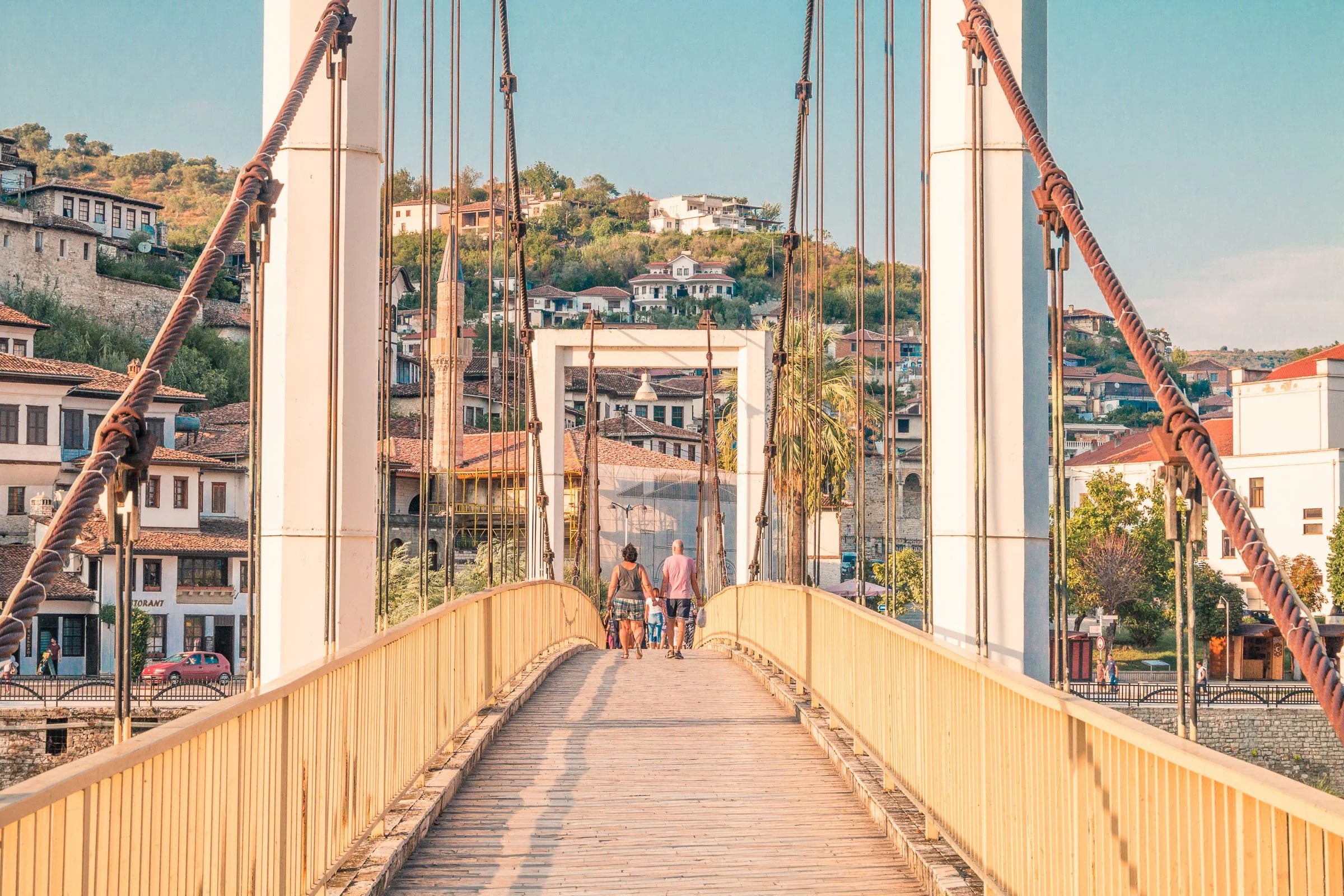
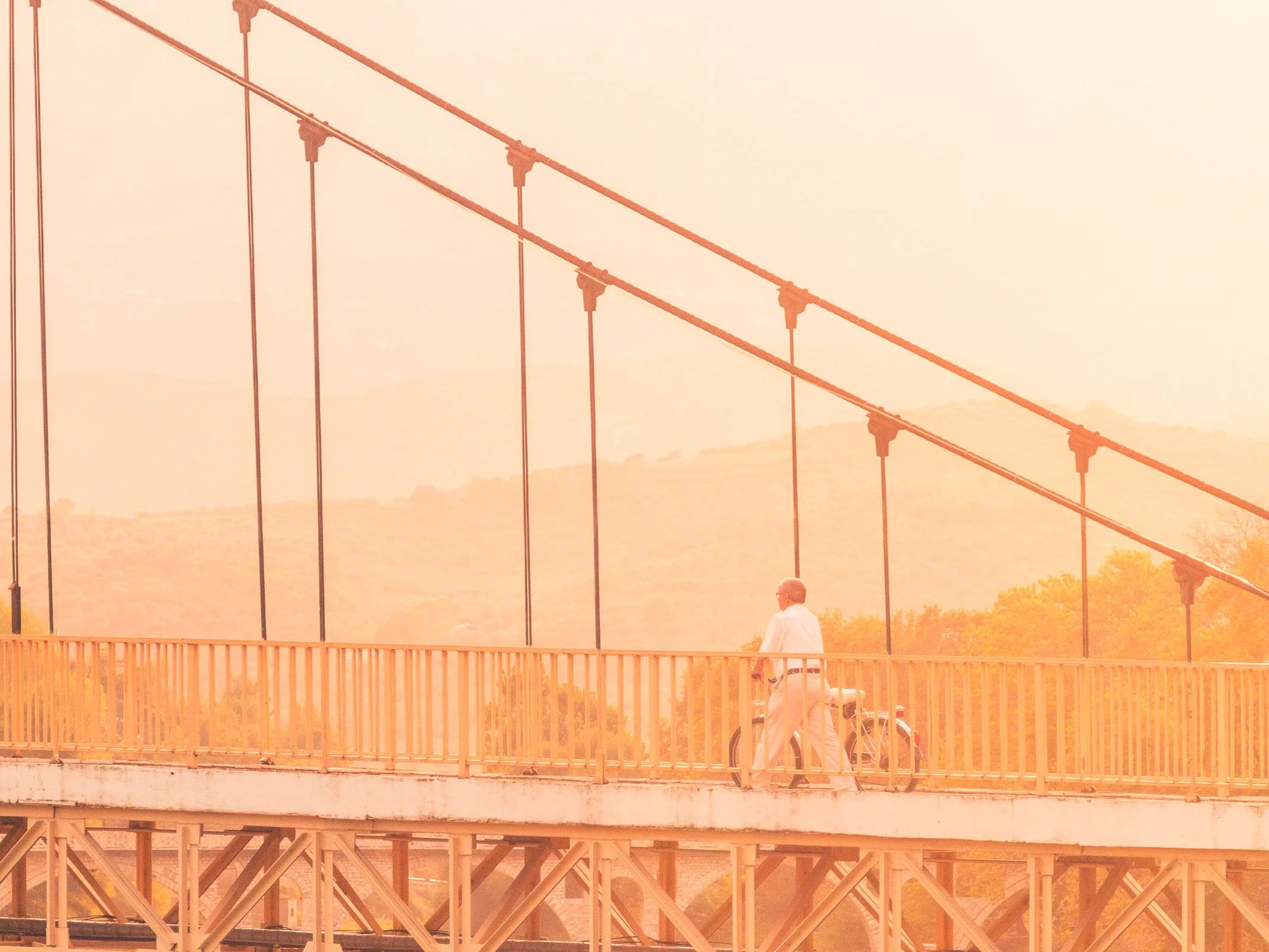
Berat’s historical heart is folded into a steep-sided river gorge, with cliff edges towering high above the river Osum. By late summer, the river is running low, wiggling across a sun-drenched bed of grasses and gravel. There are multiple river crossings and the footbridge connects the centre of Gorica with Mangalem. It's a modern bridge without special historical status, but it’s a great place for architectural shots and for people-watching.
Standing on the footbridge itself offers views to the north (towards elegant stone-built Gorica bridge) and to the south (towards the commanding modern city hall with its white dome, and distant hills behind).
In the morning, the early light just catches the rooftops and angles of Mangalem. The footbridge provides interesting foreground and midground against this scenery. During late summer the valley gathers a dusty sun-baked haze, and in the late afternoon and at sunset the footbridge is fully drenched in dusty golden light. It's possible to get shots of silhouettes of people with hills in the background if you walk east of the footbridge a little and turn around to look back.
Gorica bridge
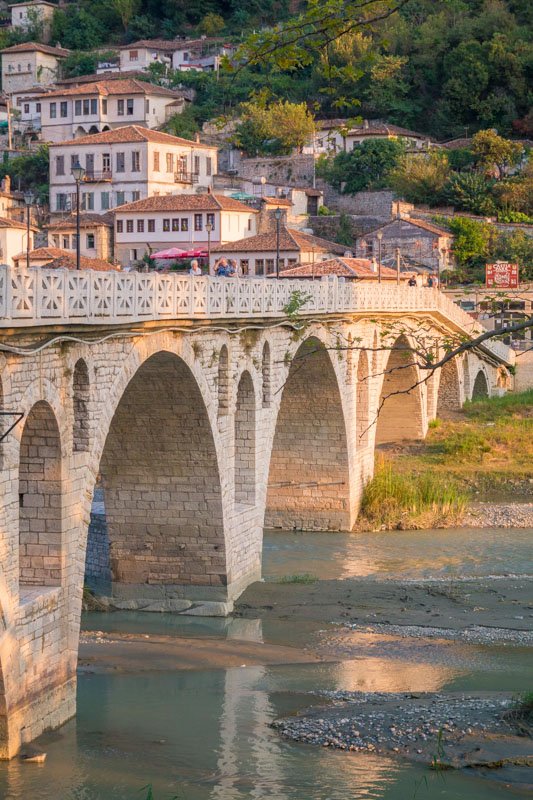
One of the oldest bridges in Berat, Gorica bridge was originally built in wood in the 1700s and then in stone 200 years later. Seven-arched, it is particularly pretty at sunset, when the sunlight is low enough to light the undersides of the arches. Standing in Mangalem, looking towards the bridge at sunset, Gorica bridge will be backlit, while light streaming through the gorge backlights the scenes in bronzy tones.
If you are interested in street photography you will find plenty of inspiration along the Mangalem waterfront between Gorica bridge and the footbridge around sunset. The golden light creates silhouettes of cyclists and pedestrians (if you face west) or bathes the riverside mosques and guesthouses in golden rays (if you face east).
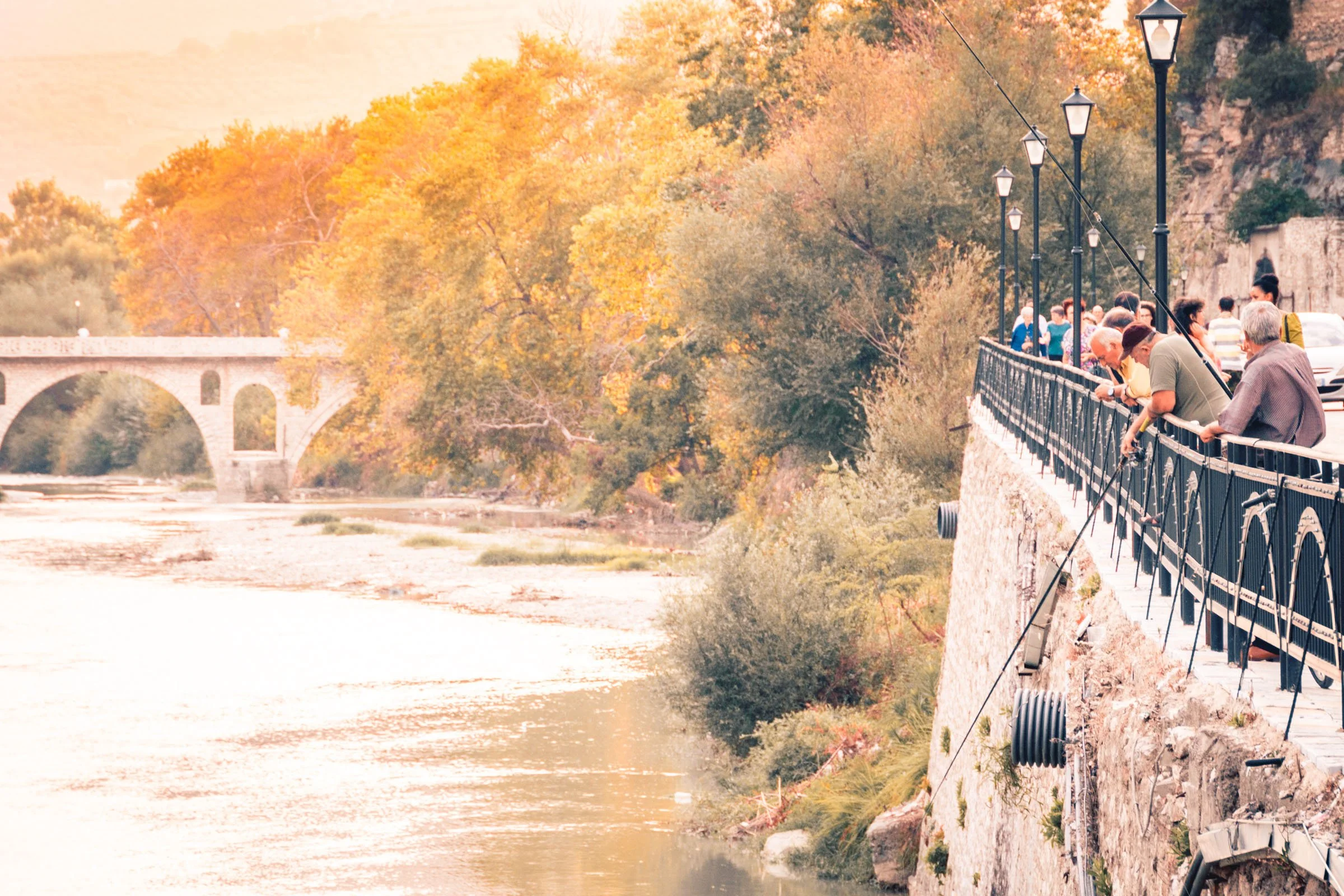
Riverfront
Berat has several bridges and beautiful old houses along both sides of the river. At sunset the riverfront fills with people out to enjoy the cooler evening. A few market stalls appear and some people fish. In summer the setting sun falls along the river gorge, creating lovely light for an hour or two before sunset.
Practicalities
I stayed at the beautiful Hotel Muzaka which is in a historical building close to Berat's footbridge, and ate at the Muzaka restaurant, which is in an open air courtyard next to the river and has great food.
The nearest airport is Tirana.
Berat is easy to drive to within Albania. The SH72 north of Berat is in good condition and provides road links to Tirana and Fier. It's around 1.5 to 2 hours to drive from Tirana. Avoid driving south from Berat towards Kelcyre as the road is not sealed all the way at time of writing (2019). For heading south, take the long route round by going north on SH27, west towards Fier, and then joining the SH4 south towards Saranda and the Greek border; these roads are in good condition all the way. Google Maps seems to recognise this and directed us via the longer route.
Major car rental firms are represented in Albania alongside smaller local car rental firms.
If you’re not driving, Berat is easy to reach, with regular buses from Tirana, Vlora, and Durresi directions. Note that buses start running early and also finish early; don’t leave your travel until the afternoon. It may be necessary to change at Fier for Tirana or for services south towards Saranda and Gjirokaster. It might be possible to make a day trip to Berat from Tirana, but be aware that the last bus service is often mid-afternoon, so check the timetables carefully. Personally I'd recommend staying at least 1 night in Berat (I stayed for several days) as there are a few things to see.
Berat centre is very small and everywhere is walkable - a car is completely unnecessary to see the town. The historical city centre is small and easily navigated on foot. Some areas are cobbled and/or steep, though, and not very accessible for the less mobile. Most of the attractions here can be reached by car in that case, although the ancient streets are somewhat tight in a modern car and you may prefer to hire a local taxi as transport rather than attempt it yourself.
Local tourism information can be found here.
I paid for all aspects of the trip with my own funds.