Senja-
Andøya
ferry
In summer there’s a fantastic ferry that directly connects two Norwegian Scenic Routes (Senja and Andøya). But it’s not all smooth sailing. Here’s what you need to know.
You can finish one spectacular Norwegian Scenic Route on the beautiful island of Senja, drive onto the ferry, and exit less than 2 hours later straight onto another Scenic Route, on the island of Andøya! The Routes even start/end at the ferry terminal to make it easier.
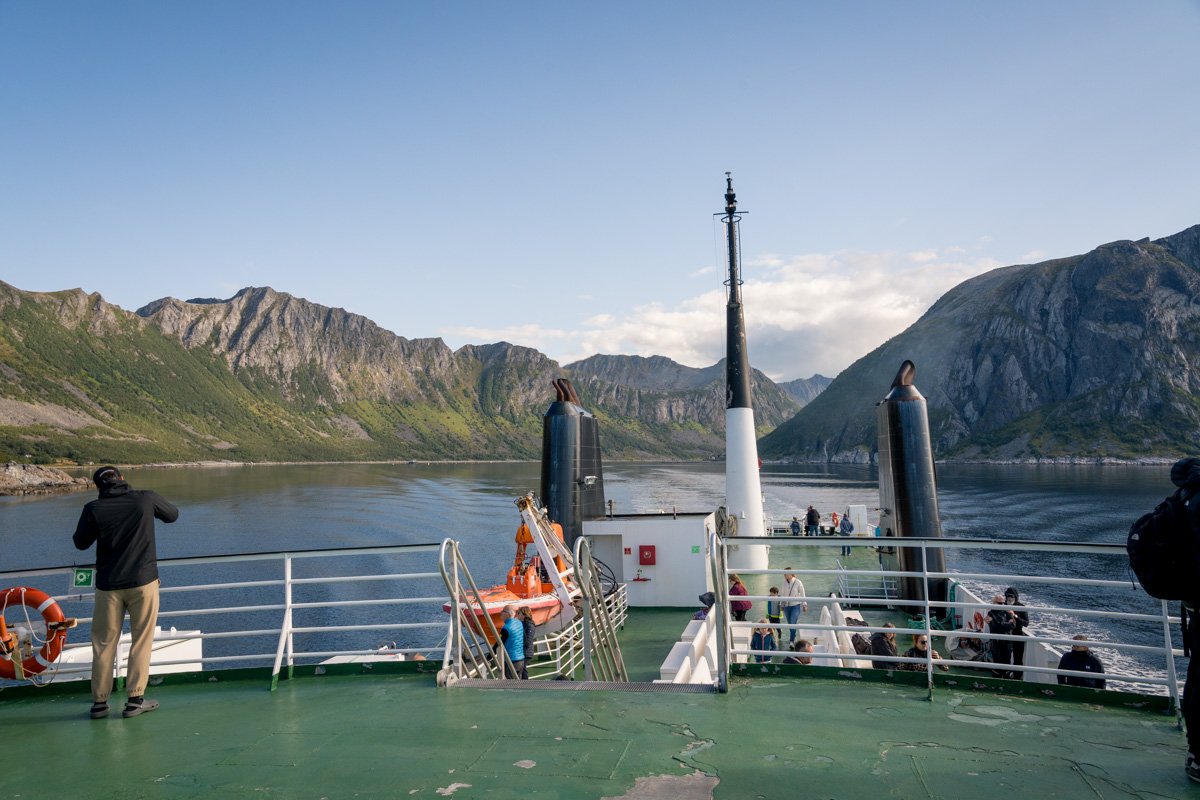
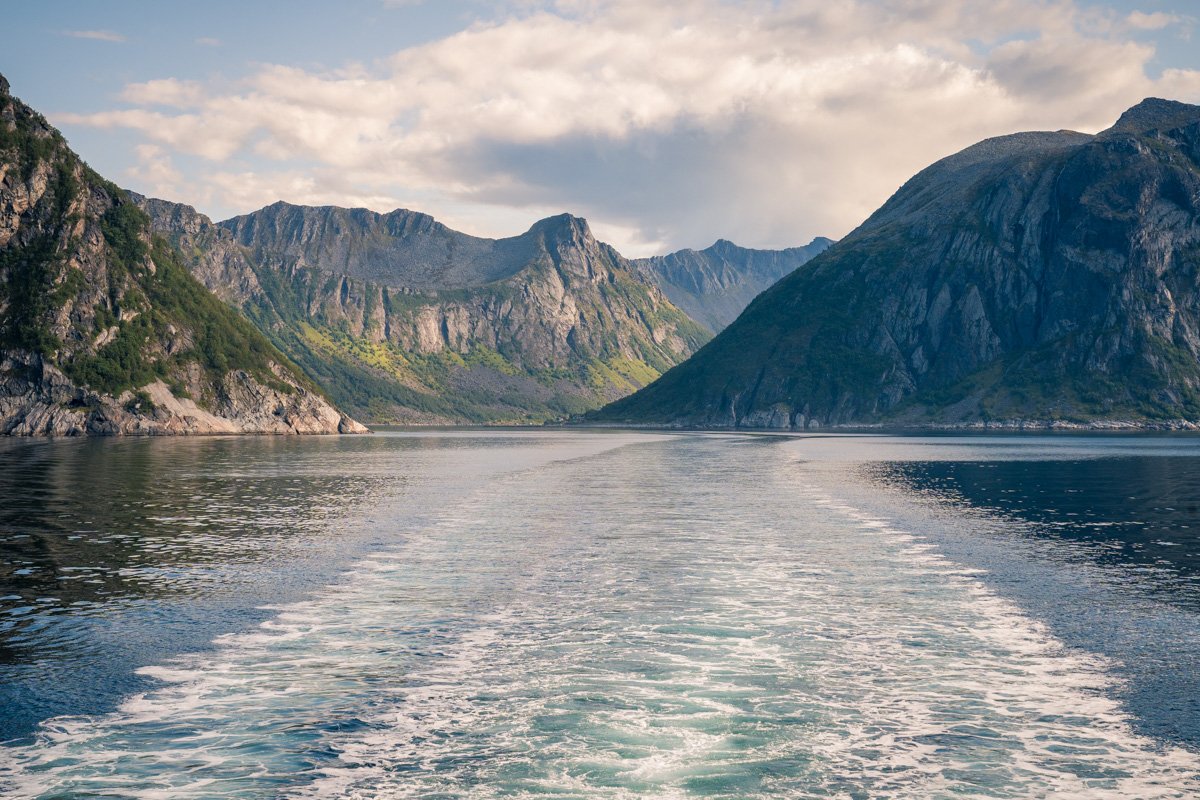
The ferry journey itself also a smashing trip, that joins two very different towns. Andenes, on long, thin Andøya island, is a flat, breezy and scrubbed-clean seaside town, famous for whales. Meanwhile, Gryllefjord, on Senja, is an active fishing village, sheltered from the open ocean by its location, tucked halfway down a steep and narrow fjord. As you sail between the two, hazy mountains and distant fjords hover to the south throughout the trip.
It sounds fabulous, right? There is a catch, though. There is no way to guarantee departure on a specific sailing, because the ferry cannot be booked ahead. You just turn up and drive onto the next available crossing. However, demand for this particular ferry far outstrips supply. As a result, vehicles are left behind on the quayside throughout the busy season. Left behind, drivers will have to choose between driving the long way round, or waiting five hours or more for the next sailing.
On this page, I’ll discuss:
Planning the trip
Now that you are forewarned, you can decide how to approach the journey. The options available to you vary depending on the time of year. The ferry is completely halted all winter (and bear in mind that “winter” up here is very long). In summer the ferry has two schedules: in high summer it sails 3 times a day each way. And in shoulder season it sails twice a day in each direction. So it’s important to check the timetables very carefully when planning your trip.
During the height of summer, when there are 3 sailings a day, it’s important to arrive well before your preferred targeted departure. It’s likely that at least one ferry will depart without you, while you are waiting, so allow enough time for this.
During shoulder season, the number of tourists falls a little and there are two sailings a day. Make sure you arrive at least three hours before departure, preferably four. Based on my experience (in September) this will probably be sufficient to get you on the next sailing - but there are no guarantees.
Below I’ll explain how the ferry terminal works and how to work out whether you will be boarding the next sailing.
Gryllefjord
Arriving at the ferry dock in Gryllefjord
The ferry dock on Senja is at Gryllefjord. The dock consists of a car parking area tucked in between the waterfront and a Joker supermarket. There is a small indoor waiting room with a sink and toilets, as well as the supermarket, and (in-season) a snack and coffee van. There are no ferry staff manning the dock itself except when the ferry is present.
Looking at the car parking area, you’ll see that there are 6 lanes painted on the dockside, all numbered. Lanes 1-5 are lined up parallel to each other on the dock, in front of the supermarket. Lane 6 sits behind these, alongside the main road next to the supermarket.
When you arrive, make sure to park in the next available space, strictly following the numbering (e.g., if lane 4 is full, do not try to squeeze into lane 3, even if you think there is space – you must park now in lane 5). If lane 6 is full, you should park up behind it, forming a queue along the main road. Avoid blocking the road itself.
Vehicles will board in the order in which they arrived.
About 30 minutes before the scheduled departure, the boat will arrive at Gryllefjord, and the passengers and vehicles already onboard will disembark. The crew then begin to move through the lines of waiting traffic, scanning number plates of the vehicles they expect to be able to load for the return sailing.
When it is ready for boarding, ferry staff will start to allow vehicles onto the ship, starting with Lane 1. Their task is to squeeze vehicles into the car deck as efficiently as possible. It’s like assembling a jigsaw. Larger vehicles go where there is available room, and smaller vehicles squeeze in around them. For that reason, sometimes the staff will ask you to wait while some vehicles behind you go first; they are trying to fill all available spaces and they need vehicles with a different size first. Don’t worry – they will come back to you once there is an appropriate space for you.
How to work out whether you will be boarding the next boat?
You can make a rough guess whether you are likely to be able to catch the next boat, although this only applies to the Gryllefjord dock – I haven’t taken the sailing from Andenes and I don’t know the dock there. This applies to vehicles only, not foot passengers.
If you are waiting to take the ferry from Gryllefjord:
In my experience, vehicles in Lanes 1–5 will usually make the next sailing.
From what I observed, some of the vehicles in Lane 6 can also board, potentially all of Lane 6. This might vary, depending on how many vehicles are in the lanes ahead of you, how tightly packed they are in the lanes, and their sizes (are they all large campervans or are they smaller cars?)
Again, from my observations, vehicles outside Lane 6 may make it on board, but are likely to be waiting for the next boat.
If you arrive at the ferry dock and all the lanes 1-6 are already full with additional vehicles waiting, you will likely have to wait for the second sailing. Depending on the season, waiting for the next boat will mean a minimum wait of four to five hours, or even overnight.
If you are intending to catch a sailing later in the day, arrive early for your sailing (at least 3 hours ahead during shoulder season, 5 or more hours in peak of summer) to obtain a spot in the queue, and be prepared to spend some time in Gryllefjord while you wait. Have some snacks or a meal, and see my suggestions below of how to kill some time.
Strategies
Waiting for the next sailing is annoying if you are not prepared for it, but if you can plan ahead it’s not the end of the world.
If you are intending to catch the first sailing of the day, and you have a campervan, just arrive the evening beforehand, obtain a spot in the queue and stay there overnight. The ferry dock has a waiting room open during the daytime, with a sink and toilets. There is also a supermarket right next to the terminal.
If you don’t have a campervan, consider booking accommodation in Gryllefjord the night before your intended sailing. You could also try Torsken, which is less than 10 minutes’ drive away and puts you close by in the morning.
If you don’t have a campervan, and it is well into shoulder season (when demand has fallen), you could just turn up early. In September we arrived around 4 hours early for the first sailing of the day, and we found ourselves near the front of Lane 5 and made our intended crossing. This will, of course, be easier if you are staying in or near Gryllefjord.
During peak season, you will have to turn up well before your targeted departure, and just plan how to spend your time waiting.
What to do in Gryllefjord while you wait
Gryllefjord is a perfectly nice place, with a few nice views to check out.
The town is long and thin, spread out along the side of the fjord. For a very short walk, you can walk right to the end of the road, from where you can see Andøya in the distance if it is clear. The sun shines straight into your face in the evening in this direction, and from behind – over your shoulder – by late morning. There are a few crumbling old overwater cabins and piers here.
There are a couple of small cafes/restaurants in the village, where you could just sit down for a drink, meal or snack. Check opening hours/dates carefully. The supermarket also sells coffee and snacks.
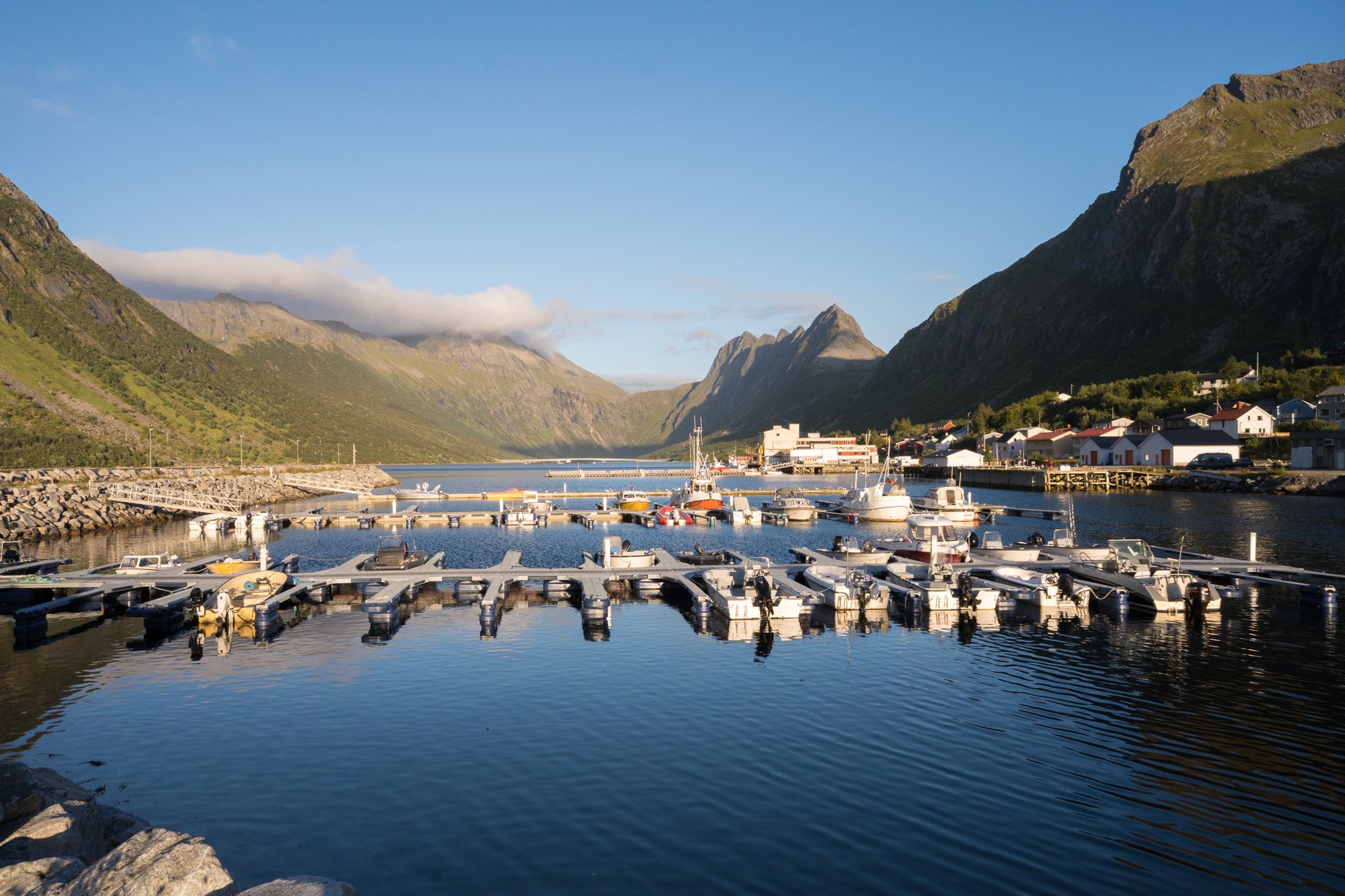
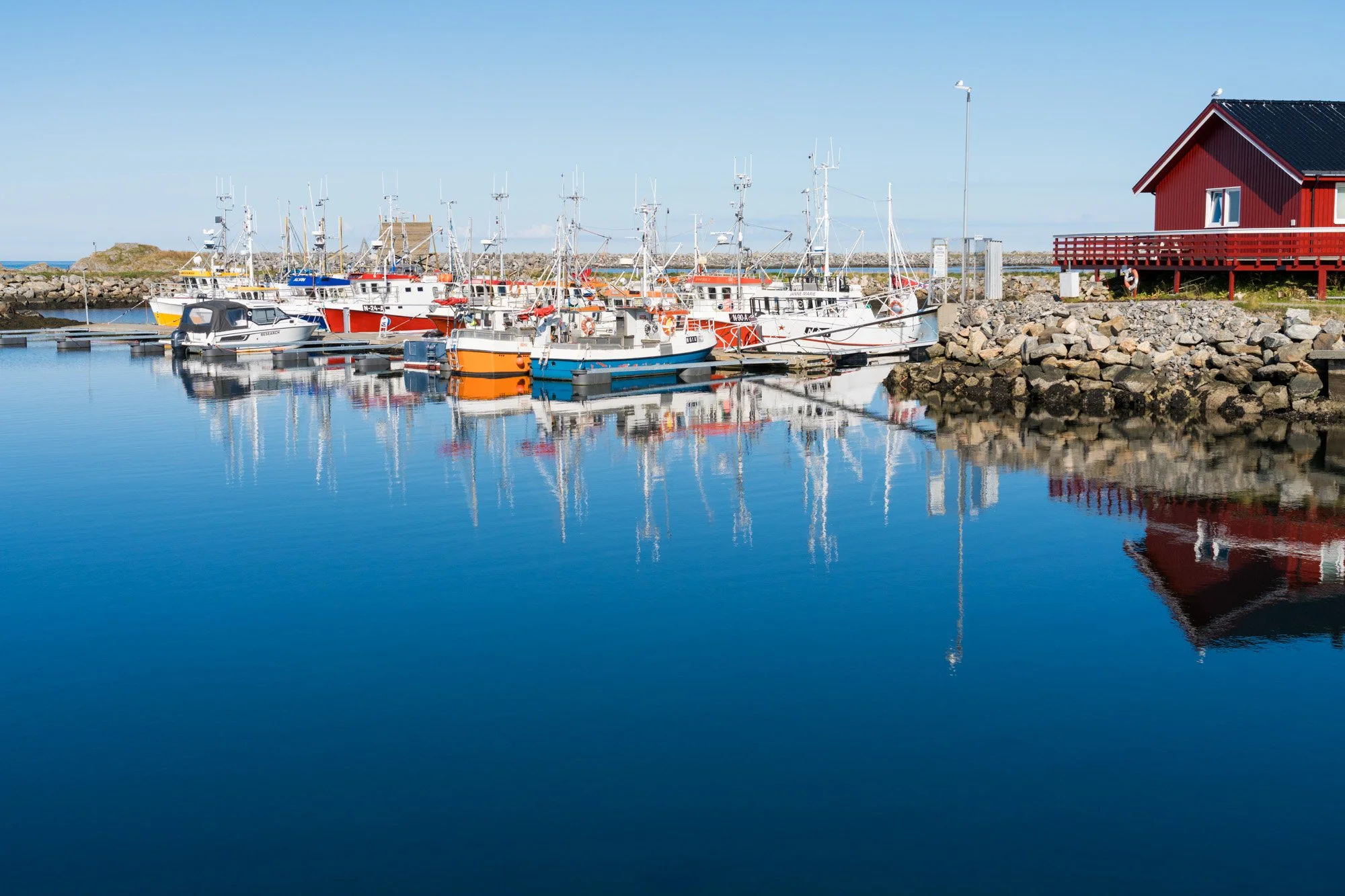
You can walk out on the village breakwater for better views of the fjord – it’s right next to the ferry dock. There’s a little marina here, and the water in the fjord is very sheltered, so on a calm day there are fabulous reflections, and it’s a nice place to sit with your coffee from the coffee van, or some lunch snacks. The view towards the head of the fjord is fantastic – just a little ruined by the industrial fishery buildings on the edge of the town. On a sunny day, the sun shines straight from behind you in the afternoon/evening as you walk out onto the breakwater; in late morning the sun will be shining on your face.
You could walk inland and up the hairpins to get a nice view over the fjord (a great viewpoint). In the late afternoon/early evening in late summer, the sun may even be shining into your face, down the length of the fjord, which creates some lovely lighting.
If you know you have a long wait ahead of you and you’re a confident walker, you could try taking one of several walks in the area. Of course, check all timings very carefully so you don’t miss the boat.
Useful links and sources of information
Here are links that may be helpful:
Local tourist information is available at at Visit Vesterålen and Visit Senja as well as the Northern Norway Tourist Board
Bus timetables for Senja are here and bus time tables for Vesterålen
Heart My Backpack and Life In Norway are both wonderful blogs, packed with heaps of useful information if you are planning a trip to Norway
If you want to explore Norway’s National Tourist Scenic Routes (Nasjonale Touristveger) you can read about all 18 routes here
You’ll need access to good quality weather forecasts to plan your photography sessions. In Norway I use yr.no